

Sleep Tracking Devices: What They Measure
You slip off your smartwatch before bed, and as you drift off, a tiny light sensor beneath your wrist begins its nightly work, measuring your heartbeat hundreds of times per minute. Across your body, accelerometers detect every turn, every shift in position, every moment of stillness. By morning, your device has recorded thousands of data points, processing them through algorithms to tell you something remarkably intimate: exactly how you slept last night.
But here's what most people don't realise: your sleep tracker isn't actually watching your sleep the way a doctor would. It's making educated guesses based on indirect signals. Understanding what these devices actually measure, how accurate they are, and what you can genuinely trust them for will change how you interpret that nightly data.
Why This Matters to You Right Now
Sleep tracking has moved from fitness enthusiast niche to mainstream reality. 93.5 million Americans now use sleep tracking devices, representing 27.4% of the entire U.S. population.1 Globally, 210 million people actively track their sleep.1 The sleep technology market, worth $24.9 billion in 2024, is projected to reach $134.7 billion by 2034: a staggering 5.4 times growth in just a decade.1
This explosive growth means better devices are coming. But it also means millions of people are making decisions based on data they may not fully understand. 77% of users find sleep trackers helpful1 but the remaining 23% struggle with either the accuracy or the psychological impact of obsessing over metrics that might not mean what they think they mean.
How Sleep Trackers Actually Work: The Technology Behind the Numbers
Your sleep tracking device isn't passively watching your brain. Instead, it layers multiple sensor technologies, each measuring a different physiological signal. These signals feed into proprietary algorithms that make educated guesses about what's happening whilst you sleep.
Photoplethysmography: Reading Your Heartbeat Through Light
The most fundamental sensor in any wearable sleep tracker uses a simple principle: light and blood react in predictable ways.
Here's what happens: an LED light (usually green, red, or infrared depending on the device) shines through your skin into the tissue beneath.2 A photodetector measures how much light bounces back. When your heart beats, blood volume in your arteries changes; more blood absorbs more light, creating a tiny dip in the reflected signal. Each dip represents one heartbeat. By measuring the timing between dips, the device calculates not just your heart rate but also heart rate variability, which is the millisecond-by-millisecond fluctuation between beats.2
Why this matters for sleep: your heart rate pattern changes dramatically between sleep stages. During deep sleep, your heart rate drops and becomes steady. During REM sleep (the dreaming stage), your heart rate rises and becomes more variable. The device recognises these patterns and uses them to infer which sleep stage you're in.2
Sleep rings like the Oura Ring have a particular advantage here. Your finger has thinner skin and more prominent blood vessels than your wrist, so infrared light penetrates more effectively. The ring also sits more consistently on your finger than a watch on your wrist; watches slip during sleep, watches rotate, watches change contact pressure as you move. This stability gives ring trackers a cleaner signal and explains why research consistently shows rings outperforming watches for sleep stage accuracy.2
Accelerometers: Detecting Movement
Every smartwatch and fitness band includes motion sensors called accelerometers. These measure acceleration along three axes: left to right, up and down, front to back. Sleep tracking devices use accelerometers to detect when you're moving versus when you're still.3
The principle is straightforward: sleep is characterised by stillness. When you haven't moved for roughly an hour, the device assumes you're asleep. When you start tossing and turning, it registers that as either wakefulness or a position change within sleep.3 Advanced devices combine accelerometer data with heart rate data to refine these guesses. A smartwatch alone using only accelerometer data can achieve about 87% accuracy distinguishing sleep from wakefulness, but adding heart rate data improves discrimination between light, deep, and REM sleep.3
Temperature Sensors: Tracking Your Body's Heat Regulation
Apple Watch Series 8 and later include dual temperature sensors that measure your skin temperature throughout the night.4 Your body temperature naturally drops by 1-2 degrees Fahrenheit as you fall asleep, reaching its lowest point around 4 a.m.4 Deep sleep is associated with the lowest core temperatures.
Temperature data is particularly useful for identifying REM sleep, because during REM, your body's ability to regulate temperature diminishes.4 It's also useful for tracking hormonal changes (like menstrual cycles) and detecting fever or illness.
Blood Oxygen Sensors: Measuring Oxygen Saturation
Some premium devices include pulse oximetry sensors that measure SpO2 (the percentage of haemoglobin carrying oxygen in your blood).5 These use two wavelengths of light: red and infrared. Different forms of haemoglobin absorb these wavelengths differently depending on whether they're carrying oxygen. By measuring absorption ratios, the device calculates oxygen saturation.5
This matters because sudden drops in blood oxygen during sleep can indicate sleep apnea or other breathing disturbances. Apple Watch's FDA-cleared sleep apnea screening (approved in September 2024) uses this technology combined with motion detection to flag potential risk.5
Under-Mattress Sensors: A Different Approach
Smart beds and under-mattress devices like the Withings Sleep Analyser use ballistography, a completely different technology from wearables.6 Pneumatic sensors under the mattress detect tiny vibrations caused by your heartbeat and breathing.6 A sound sensor also listens for snoring and breathing disturbances.6
The advantage: no wearable needed; you simply sleep naturally. The limitation: less precise than PPG for detailed heart rate analysis, and directly affected by bed partners (their movements confuse the system).6
What These Devices Measure: 14 Sleep Metrics Explained
Modern sleep trackers measure or estimate over a dozen distinct metrics. Let's walk through what each one means, how the device measures it, and why general readers should care.
1. Total Sleep Duration
What it measures: Total hours and minutes you sleep per night.7
How devices measure it: When your accelerometer detects minimal movement for extended periods and your heart rate pattern matches sleep signatures, the device marks that time as sleep. Add up all those sleep periods, subtract any detected wake time, and you get total sleep duration.7
Why you should care: Sleep duration is foundational. Adults need 7-9 hours nightly for cognitive function, metabolism, immune system strength, and cardiovascular health.7 The difference between 6 and 8 hours isn't just 2 extra hours; it's often an extra full sleep cycle, meaning an additional round of physical repair and memory consolidation.
Normal ranges: 7-9 hours per night is recommended.7 Currently, 36.1% of U.S. adults report insufficient sleep, and the distribution shows only 31.3% of the population gets the recommended 7-9 hours.7
2-4. Sleep Stages: Light, Deep, and REM
Your sleep cycles through stages, and understanding them is crucial to interpreting device data.
Light Sleep (Stages N1 and N2): Light sleep comprises roughly 50% of total sleep time.8 It's the transitional stage between wakefulness and deep sleep, and it's when your brain begins the memory consolidation process. Problems here manifest as frequent brief arousals and fragmented sleep.8
Why you should care: If your device shows mostly light sleep, it could indicate that your sleep is being interrupted frequently, preventing you from reaching deeper, more restorative stages.8
Normal ranges: 45-50% of your total sleep should be light sleep.8 If you sleep 8 hours, that's roughly 3.5-4 hours of light sleep.
Deep Sleep (Stage N3, also called Slow-Wave Sleep): Deep sleep is where your body does most of its physical repair work.9 Your muscles strengthen, your immune system consolidates responses to threats, your brain detoxifies, and your body releases growth hormone.9 Without adequate deep sleep, you experience persistent daytime fatigue despite sufficient total sleep hours.9
Why you should care: This is what people mean when they talk about "quality sleep." You can sleep 8 hours in light sleep alone and wake up unrefreshed. Deep sleep is non-negotiable for physical recovery.
Normal ranges: Most healthy adults need 1.5-2 hours of deep sleep per night, or about 25% of total sleep time.9 This means in an 8-hour night, roughly 2 hours should be deep sleep. The concerning signal is this: if you consistently get less than 1.5 hours, you're not getting adequate physical restoration.9
REM Sleep (Rapid Eye Movement Sleep): REM is when most vivid dreaming occurs, and it's when your brain consolidates learning and processes emotions.10 REM sleep is critical for cognitive development, emotional regulation, and creative problem-solving.10 Insufficient REM is linked to depression, anxiety, poor learning, and difficulty concentrating.10
Why you should care: This is your "brain recovery" sleep. If you're sleeping only 6 hours nightly, you're cutting off the last 1-2 REM cycles of the night, which explains morning confusion and emotional reactivity.10
Normal ranges: 1.5-2 hours per night, or about 25% of total sleep.10 The pattern is important: REM sleep increases as the night goes on. Your first REM period might be 10 minutes, but by your last sleep cycle (around 6-8 a.m.), REM periods extend to 60+ minutes.10
5. Sleep Cycles
What it measures: Complete cycles of sleep progression, each lasting 90-120 minutes.11 One cycle includes light sleep, deep sleep, and REM, then the cycle repeats.11
How devices measure it: By tracking heart rate and movement changes as you progress through stages, devices can infer complete cycles.11
Why you should care: Your sleep architecture (the pattern of cycles) matters as much as total hours. Four complete, uninterrupted cycles is worse than interrupted cycles totalling the same time, but 5 complete cycles is better than 4. This is why the difference between sleeping 6 and 8 hours is so dramatic: it's not just 2 more hours, it's nearly a complete additional cycle of restoration.11
Normal ranges: 4-5 complete cycles per night for a healthy 7-9 hour sleep schedule.11 Each cycle takes roughly 90 minutes.11
6. Sleep Quality Score
What it measures: A composite metric combining multiple data points into a single 0-100 score.12 Different devices calculate this differently. Apple Health might weight sleep efficiency (time spent asleep divided by time in bed) heavily. Oura considers total sleep time, sleep efficiency, sleep latency, and wake after sleep onset.12
How devices measure it: Proprietary algorithm varies by manufacturer.12
Why you should care: Instead of juggling 10 metrics, you get a single number trending up or down. A declining score week-to-week often signals stress, illness, or environmental sleep disruption before you consciously notice you're sleeping poorly.12
Normal ranges: 85-100 is excellent; 60-85 is good; below 60 suggests something needs attention.12 Sleep efficiency (the percentage-based component) should be 85-95%.12 Below 80% sleep efficiency can indicate insomnia or frequent awakenings.12
7. Heart Rate Variability During Sleep
What it measures: The millisecond-by-millisecond variations between heartbeats, measured during sleep.13 Unlike heart rate (which counts beats per minute), HRV measures the precise timing gaps between successive beats.13
How devices measure it: PPG sensors detect each heartbeat and calculate the time interval from one beat to the next. High variation (meaning big gaps between some beats and small gaps between others) indicates a flexible, adaptive nervous system.13
Why you should care: HRV during sleep is one of the best indicators of recovery and stress resilience. High HRV correlates with better sleep quality, faster physical recovery, and better emotional regulation. Low HRV suggests chronic stress, overtraining, illness, or poor recovery.13 During deep, restorative sleep, your parasympathetic nervous system (the "rest and digest" system) dominates, creating high HRV.13
Normal ranges: 20-200+ milliseconds depending on age, fitness level, and individual baseline.13 Critical principle: don't compare your HRV to someone else's. Track your own trend. If your typical HRV is 60 ms and it drops to 40 ms, something is wrong. If it climbs to 80 ms, you're recovered and resilient.13
8. Blood Oxygen Saturation (SpO2) During Sleep
What it measures: The percentage of red blood cells carrying oxygen in your blood during sleep.14
How devices measure it: Red and infrared LEDs shine through your skin; the device measures differential absorption of the two wavelengths and calculates oxygen saturation.14
Why you should care: Oxygen is essential for brain function, heart function, and physical recovery during sleep.14 Sudden drops in SpO2 can indicate sleep apnea: repeated breathing interruptions that fragment sleep and reduce oxygen delivery.14 People with sleep apnea experience micro-arousals (brief awakenings that feel undetectable but fragment the sleep cycle), causing severe daytime fatigue despite apparently adequate sleep time.14
Normal ranges: 95-100% SpO2 is healthy.14 91-94% is mildly below normal but acceptable. 88-90% is concerning and may indicate sleep apnea. Below 88% is dangerous and requires immediate medical evaluation.14
Important note: Brief, minor dips below 95% are normal when you change sleeping position.14 What matters is sustained drops to 88% or below, especially if they correlate with snoring, witnessed breathing pauses, or severe daytime sleepiness.14
9. Respiratory Rate During Sleep
What it measures: The number of breaths per minute while sleeping.15
How devices measure it: Estimated from heart rate patterns and movement data (not directly measured by most consumer wearables).15
Why you should care: Respiratory rate reveals sleep stage, breathing disorders, and overall cardiovascular health.15 Abnormal breathing patterns during sleep cause micro-awakenings (too brief to remember consciously but enough to fragment sleep), reducing sleep quality and causing daytime fatigue.15
Normal ranges: 12-20 breaths per minute during sleep, with variation by sleep stage.15 Deep sleep typically shows slower, more regular breathing (10-18 breaths/min). REM sleep shows more variable breathing (12-20+ breaths/min).15
Red flags: Consistently above 25 breaths/min may indicate sleep apnea or anxiety and warrants medical evaluation.15
10. Body Temperature During Sleep
What it measures: Your core body temperature throughout the night, tracked via skin temperature sensors.16
How devices measure it: Thermistors embedded in the wearable measure skin temperature, which correlates with core temperature.16
Why you should care: Body temperature naturally drops 1-2 degrees as part of sleep initiation, signalling your brain that it's time to rest.16 Deep sleep is associated with the lowest core temperatures (typically around 4 a.m.). Temperature cycling affects sleep architecture quality.16 Failure to cool adequately suggests poor sleep quality, hormonal imbalance, infection, or environmental issues.16
Normal ranges: Core body temperature baseline is 98.6°F (37°C), dropping 1-2°F during sleep.16 The lowest point typically occurs around 4 a.m.16 Skin temperature (what wearables measure) is lower, typically 82-88°F depending on sleep stage and environment.16
11. Movement and Sleep Fragmentation
What it measures: Pattern and frequency of movement and position changes throughout the night.17
How devices measure it: Accelerometers detect every motion; algorithms distinguish between small sleep movements (normal) and larger movements indicating arousal or wakefulness.17
Why you should care: Fragmented sleep with excessive movement and frequent position changes prevents you from completing full sleep cycles, reducing restoration.17 Excessive movement can indicate restless leg syndrome, sleep apnea, insomnia, or poor sleep environment.17
Normal ranges: 10-15 position changes per 8-hour night is normal.17 More frequent changes suggest sleep fragmentation.17
12. Sleep Efficiency
What it measures: The percentage of time spent actually asleep divided by total time in bed.17 Formula: (Total Sleep Time ÷ Total Time in Bed) × 100.17
Example: If you're in bed 8 hours (480 minutes) but sleep only 7 hours (420 minutes), your sleep efficiency is 87.5%.17
How devices measure it: Time spent moving (indicating wakefulness) versus time spent still with sleep-pattern heart rate (indicating sleep).17
Why you should care: Sleep efficiency reveals whether your time in bed translates to actual sleep.17 Two people in bed 8 hours can have vastly different sleep quality: one sleeps 7.5 hours (94% efficiency) while the other sleeps only 6.2 hours (78% efficiency).17 The second person is wasting 1.5 hours per night trying to fall asleep or lying awake after waking.17
Normal ranges: 90-95%+ is optimal; 85-90% is good; 80-85% is acceptable but low; below 80% may indicate insomnia.17
13-14. Sleep Latency and Wake After Sleep Onset
Sleep Latency is how long it takes to fall asleep after lying down (ideal: 10-20 minutes).18
Wake After Sleep Onset (WASO) is total time spent awake after initially falling asleep (ideal: less than 20 minutes total).18
These metrics reveal whether your sleep is fragmented. Frequent awakenings prevent completion of full sleep cycles, reducing deep sleep and REM sleep.18
How Accurate Are Sleep Tracking Devices? The Honest Truth
This is where the reality diverges sharply from marketing claims. Sleep trackers are dramatically better at some measurements than others.
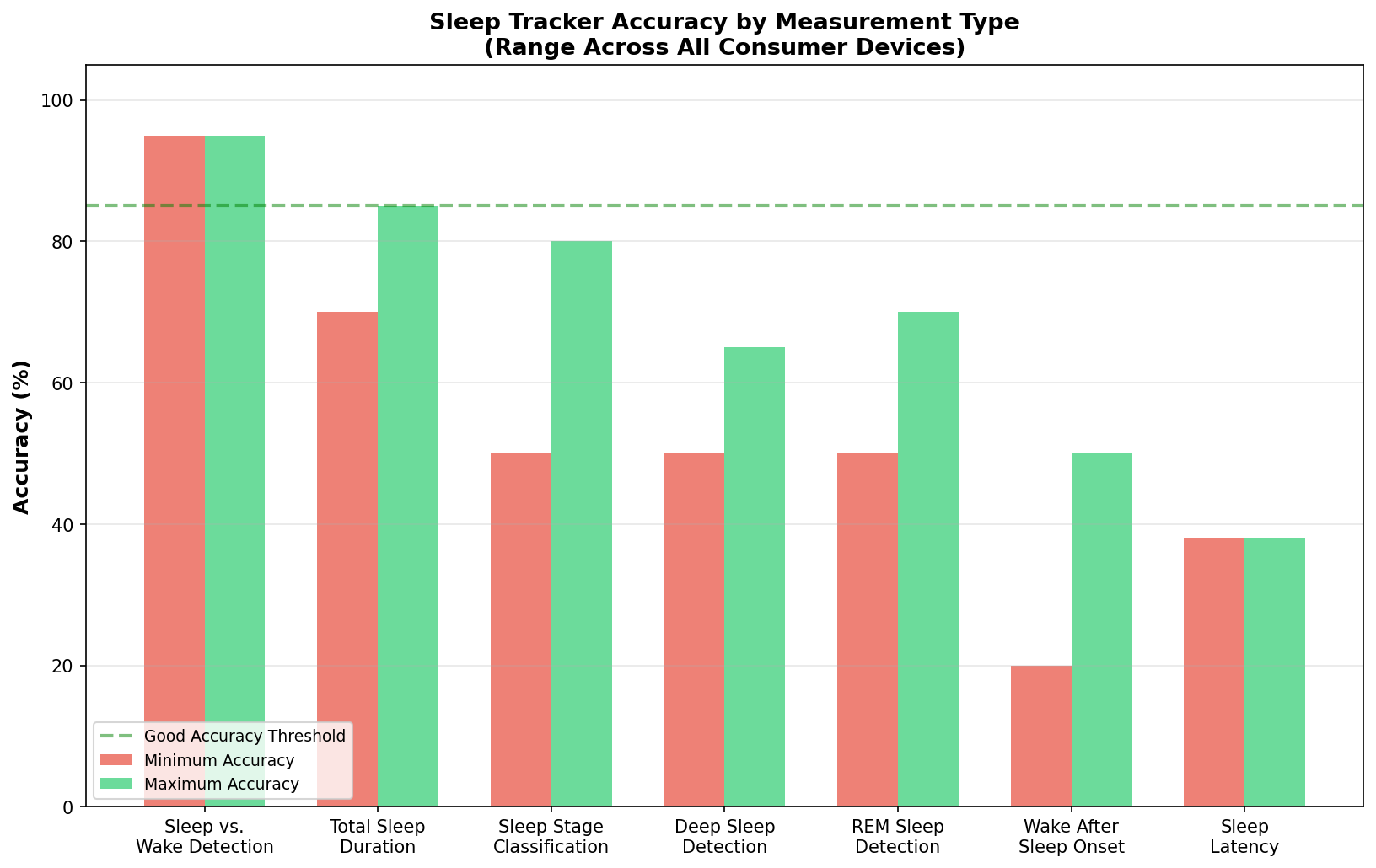 Figure 1: Sleep stage detection accuracy varies significantly by device. Oura Ring shows the most consistent performance across all stages, while Apple Watch's wide range (50.5-86.1%) indicates variable accuracy depending on which night and which user.19
What Trackers Measure Well (95%+ Accurate)
Devices excel at the most basic task: detecting sleep versus wakefulness.20 When you're actually sleeping, modern trackers correctly identify sleep 95% of the time.20 This means total sleep duration estimates are reasonably trustworthy for trends over time.
Your tracker is reliable within approximately 30-90 minutes for total sleep time.20 If your device says you slept 8 hours, actual sleep was probably between 7.5 and 8.5 hours.
What Trackers Struggle With (50-80% Accurate)
Sleep stage classification drops dramatically in accuracy.19 Sensitivity for distinguishing between light sleep, deep sleep, and REM sleep ranges from 50-86% depending on the device and stage.19
Here's what the research shows:
Deep Sleep is Hardest to Detect. All devices show greater than 20% mean absolute error for deep sleep.21 This is the least accurate metric. If your Apple Watch says you got 2.5 hours of deep sleep, your actual deep sleep could be anywhere from 1.5 to 3.5 hours depending on the night.21 Apple Watch specifically overestimates deep sleep by an average of 43 minutes per night, making your sleep quality appear better than it actually is.21
Light Sleep is Frequently Overestimated. Devices often confuse motionless wakefulness (lying still but awake) with light sleep.21 Apple Watch overestimates light sleep by an average of 45 minutes per night.21 If your watch shows 4.5 hours of light sleep, you probably actually got closer to 4 hours.21
REM Sleep is Most Reliable Among Stages. REM sleep has more distinctive heart rate and breathing characteristics that sensors detect well, making it the most accurately measured sleep stage.19 This is the least problematic sleep stage estimate on your tracker.19
Wake Detection is Terrible. This is the worst accuracy metric. Devices detect actual wakefulness only 20-50% of the time if you lie perfectly still.22 If you're awake but motionless, your tracker thinks you're sleeping. This is devastating for people with insomnia: their fragmented sleep looks far better on their device than it actually is.22
Device Rankings: Which Is Most Accurate?
Research comparing consumer trackers against polysomnography (the clinical gold standard that measures brain waves, eye movements, and muscle activity) reveals a clear hierarchy:
Winner: Oura Ring Generation 3. The Oura Ring demonstrates 76-79.5% sensitivity consistently across all sleep stages.19 It doesn't significantly overestimate or underestimate any stage. This is the most reliable consumer wearable for sleep stage measurement.19 The ring is 5% more accurate than Apple Watch and 10% more accurate than Fitbit in 4-stage sleep classification.19
Why is it better? Finger-based sensors have thinner skin and more prominent blood vessels than wrists, creating a stronger, cleaner PPG signal.19 Fingers also move less during sleep and stay in more consistent position than wrists.19
Runner-Up: Fitbit Sense/Sense 2. Fitbit shows 61.7-78% sensitivity depending on sleep stage.19 It has the advantage of being affordable and user-friendly. There's a systematic bias (underestimates deep sleep by 15 minutes on average), which is at least predictable.19
Most Popular but Not Most Accurate: Apple Watch Series 8-10. Apple Watch shows wide variability (50.5-86.1% sensitivity), with deep sleep being particularly problematic at only 50.5% accuracy; this means it gets deep sleep correct barely more often than a coin flip.19 However, Apple Watch excels at light and REM detection (86% and 82.6% respectively).19
The critical issue: Apple Watch overestimates your total sleep by adding roughly 85-90 minutes per night on average.21 If you slept 6 hours, Apple Watch might tell you 7 hours. This creates false confidence in sleep quality.21
Others Worth Noting: WHOOP 4.0 overestimates total sleep time by only 8.2 minutes on average, making it the most accurate for the most important metric.19 Garmin Vivosmart 4 performed poorly in most metrics and isn't recommended for detailed sleep tracking.19
The Missing Data: What Trackers Cannot Measure
This is critical for understanding limitations. Clinical sleep studies use polysomnography, which directly measures brain waves (EEG), eye movements (EOG), muscle activity (EMG), and breathing.23 Consumer trackers never measure these signals. Instead, they infer sleep stages from indirect measurements: heart rate, movement, and occasionally temperature.23
A person can lie perfectly still while awake, and your tracker will classify it as sleep, because stillness plus a resting heart rate looks identical to light sleep from the tracker's perspective.23 This is especially problematic for insomnia patients, whose fragmented sleep with frequent micro-awakenings is typically underestimated.23
Why Accuracy Varies So Much
Understanding why devices are inconsistent helps you interpret the data wisely.
Personal Factors
Your individual physiology affects tracker performance.24 Age, body composition, fitness level, sleep position, and bed-sharing all influence accuracy.24 Most validation studies tested young, healthy individuals in lab settings, so accuracy may differ in real homes, with older adults, or with people who have existing sleep disorders.24
The Proprietary Algorithm Problem
Each company keeps its sleep-scoring algorithm secret.23 This means you can't actually know what "deep sleep" means on your Fitbit versus your Apple Watch.23 Your Fitbit's definition might emphasise heart rate patterns, while Apple Watch might weight movement differently. The same physiological state could be classified as deep sleep on one device and light sleep on another.23
Systematic Biases in All Devices
Every consumer tracker exhibits the same patterns: they overestimate sleep on nights with few awakenings and underestimate sleep on nights with many awakenings.25 They overestimate light sleep while underestimating deep sleep.25
Sleep Apnea Detection: The Exception (FDA-Approved)
Apple Watch received FDA approval in September 2024 for screening risk of moderate-to-severe sleep apnea, using accelerometer-based motion detection to identify breathing pattern interruptions.26 Samsung Galaxy Watch also received FDA clearance. Withings received EU approval in early 2025.26
It's important to understand what "FDA-approved" actually means here: Apple Watch can flag potential risk, encouraging users to seek formal sleep testing.26 But it cannot diagnose sleep apnea. Formal polysomnography is still mandatory for diagnosis.26
Which Devices Should You Choose?
Based on accuracy data, here's the hierarchy:
If sleep stage accuracy is your priority: Oura Ring Generation 3 is the most reliable consumer option.19 Expect 76-79% accuracy for sleep stages, with minimal systematic bias.19
If ecosystem integration matters: If you already own Apple devices (iPhone, iPad, Mac), your Apple Watch data integrates seamlessly into Apple Health.27 Same with Fitbit and Google Pixel users.27 This ecosystem convenience often matters more than a 5% accuracy difference.19
If budget is a concern: Fitbit Charge or Fitbit Sense offers decent accuracy at a lower price point than Oura Ring.19
If you want the best total sleep time tracking: WHOOP 4.0 is remarkably accurate for the most important metric, overestimating by only 8 minutes on average.19
If you want no wearable: Under-mattress sensors like Withings Sleep Analyser avoid needing to wear anything, but they cannot reliably detect sleep stages; they can only detect basic sleep/wake and breathing disturbances.28 They're best used alongside a wearable if you want stage data.28
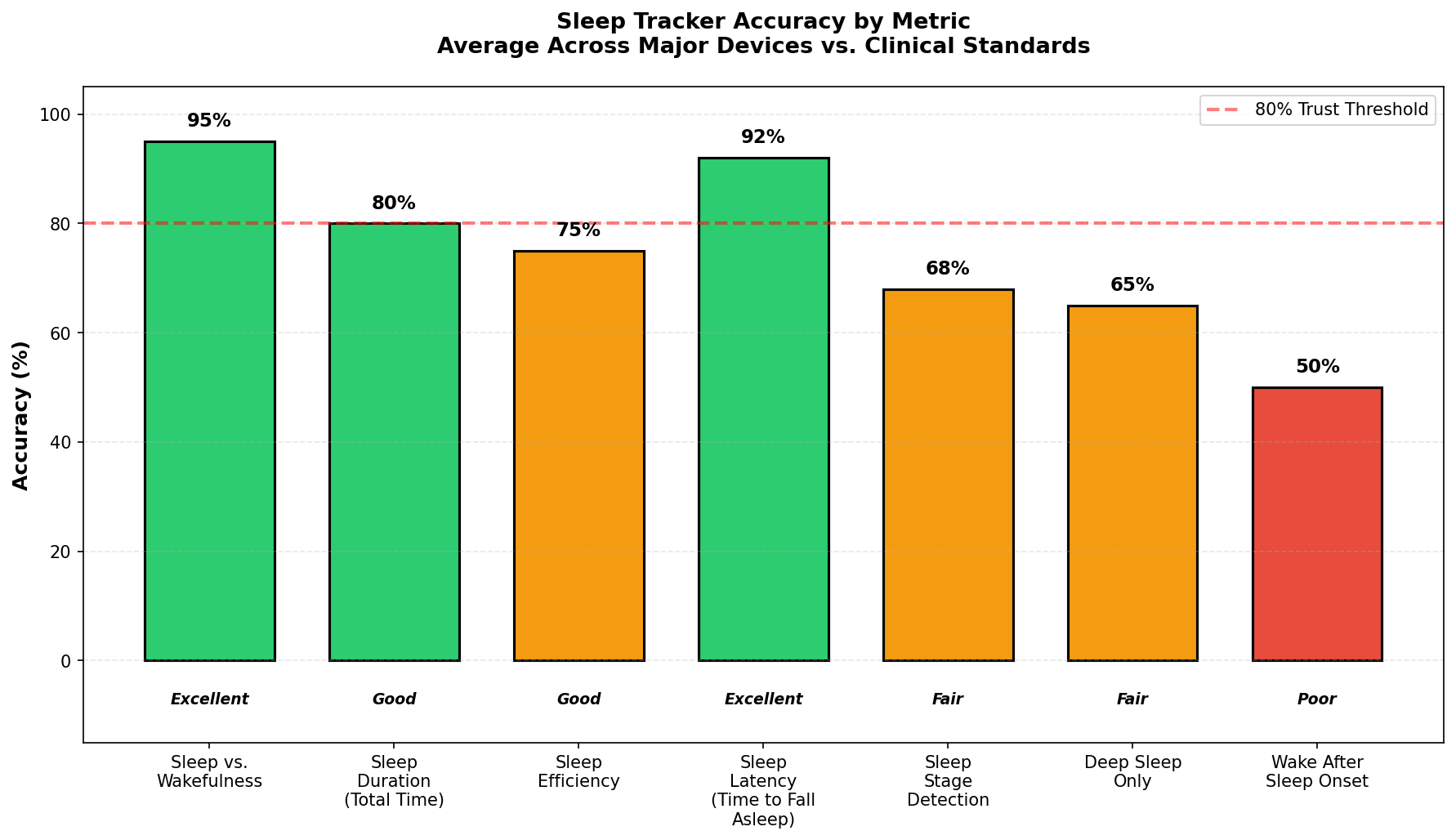 Figure 2: Market dominance doesn't always mean best accuracy. Apple Watch leads in market share (28%), but research shows Oura Ring (just 5% market share) is more accurate for sleep stages.1
Critical Limitations: What Sleep Trackers Cannot Do
Understanding these limitations prevents misuse:
Cannot Diagnose Sleep Disorders
Devices cannot diagnose obstructive sleep apnea, insomnia, narcolepsy, restless leg syndrome, or REM sleep behaviour disorder.29 They can flag risk, but diagnosis requires formal sleep study with polysomnography.29 If you suspect a sleep disorder, see a sleep specialist, not a sleep tracker.29
Struggle With Fragmented Sleep
Accuracy drops significantly on nights with low sleep efficiency (many awakenings).30 If you have insomnia characterised by frequent micro-awakenings, your device will likely show better sleep than you actually experienced.30
Cannot Measure Brain Waves
Since sleep stages are defined by brain wave patterns, and consumer devices don't measure brain waves, all sleep stage estimates are guesses based on heart rate and movement.23 Some guesses are better than others, but none are definitive.23
Affected by Bed Sharing
If you share a bed with a partner, their movements can confuse the tracker's motion sensors.24 Smart bed technology has advantages here, but ring and watch trackers often misattribute partner movement to the wearer.24
How to Use Sleep Trackers Wisely
Based on research, here's what you can confidently rely on and what you should ignore:
Trust These
Trends over weeks and months. Your device is consistent with itself. If your average sleep duration increases over four weeks, that trend is likely real.31
Total sleep duration, roughly. Within 30-90 minutes, device estimates are reliable for trending.31
Whether you're sleeping more or less than usual. Week-to-week comparisons are trustworthy.31
General patterns. "I sleep worse when I exercise after 7 p.m." or "My sleep is fragmented on stressful work days".31
Be Cautious With
Individual night sleep stage breakdowns. Each night has 50-80% accuracy. Don't obsess over whether you got "enough" deep sleep in a single night.19
Exact percentages of light versus deep versus REM. These vary device to device and person to person.19
Deep sleep numbers from Apple Watch. The 43-minute average overestimate makes these numbers unreliable.21
Don't Rely On
Clinical diagnosis of sleep disorders. Professional sleep study is mandatory.29
Device data as proof you don't have insomnia. Devices underestimate fragmented sleep; if you feel unrefreshed, see a sleep specialist.22
Single-night accuracy. One night's data has too much error to be meaningful.31
The Bottom Line: Trust Trends, Not Nights
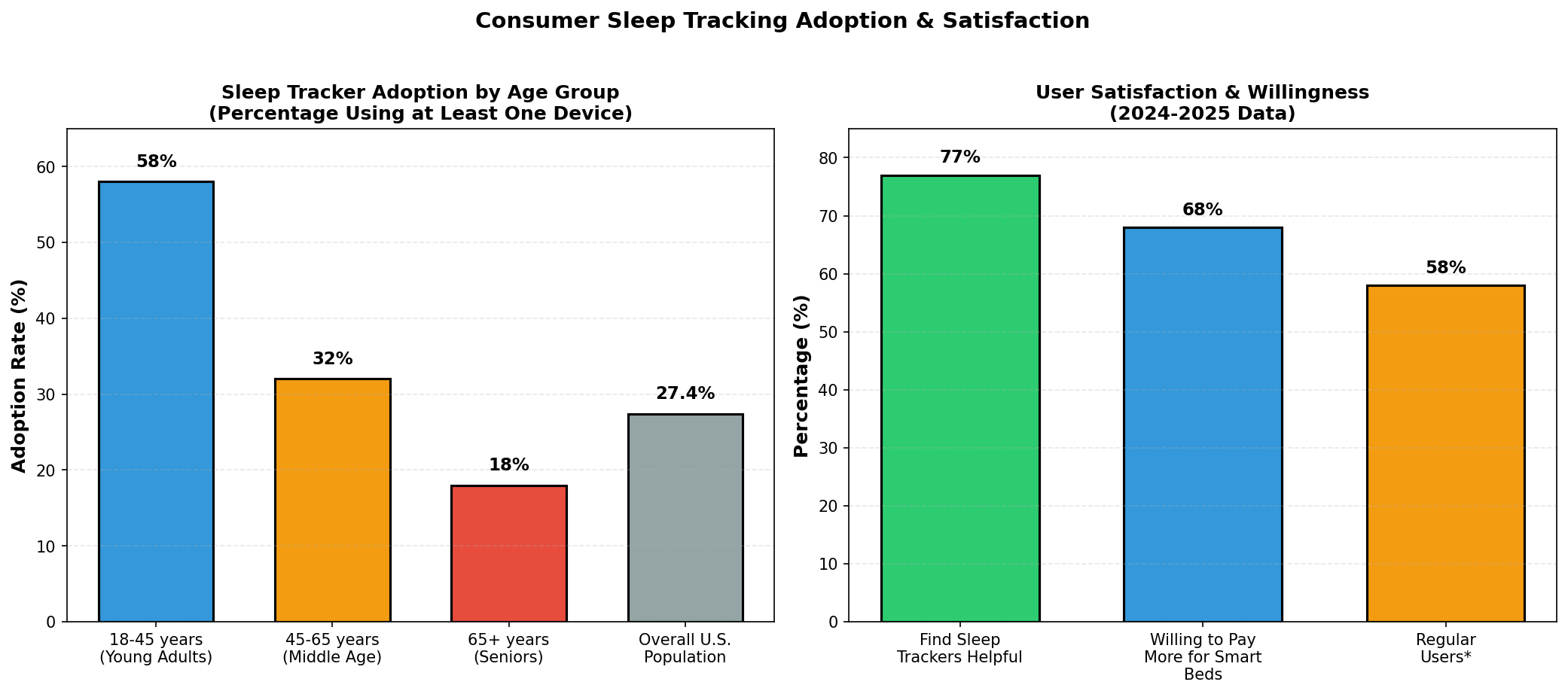 Figure 3: Healthy sleep architecture shows roughly half light sleep, one quarter deep sleep, and one quarter REM. Your device's single-night breakdown may differ from these proportions, but weekly averages tend toward these targets.8
Sleep trackers have become mainstream because they do provide value, just not in the way most people think. They're not precision medical instruments. They're motion and heart-rate sensors making educated guesses about what's happening in your brain.23
But they're also not useless. Tracked over weeks, sleep data reveals patterns you'd otherwise miss.31 They provide motivation. They create accountability. They show you objectively whether that new sleep schedule actually improved your sleep (trends don't lie; individual nights do).
The key insight? Trust the trends, not the individual nights.31 When your average sleep duration improves from 6.5 to 7.5 hours over a month, that's real. When your weekly sleep quality score trends upward, that indicates change. But don't obsess over tonight's 1.8 hours of deep sleep versus last night's 1.5 hours; those numbers have too much error to be meaningful.19
If you suspect a sleep disorder, a sleep tracker cannot replace a clinical sleep study. But as a tool for understanding your general patterns, creating accountability, and motivating better sleep habits, sleep trackers offer genuine value. Use them wisely.
Further Reading
Understanding Sleep Science
- Sleep Foundation: Stages of Sleep and Why They Matter
- Cleveland Clinic: Sleep Basics and Sleep Cycles
- NIH National Heart, Lung, and Blood Institute: How Sleep Works
- World Sleep Society: Recommendations for Sleep Tracking
Device Accuracy and Validation
- Performance Validation of Six Commercial Wrist-Worn Wearable Sleep-Tracking Devices
- Accuracy of 11 Wearable, Nearable, and Airable Consumer Sleep Trackers
- Accuracy Bias and Factors Influencing Consumer Sleep-Monitoring Devices
- Performance of Seven Consumer Sleep-Tracking Devices Compared to Polysomnography
- Evaluating Accuracy in Five Commercial Sleep-Tracking Devices
Sensor Technology and How It Works
- Wearable Photoplethysmography Sensors Review
- IEEE Pulse: Advanced Sleep Sensors and What They Measure
- Comprehensive Review of Home Sleep Monitoring Technologies
Clinical Perspective
- Johns Hopkins Medicine: Do Sleep Trackers Really Work?
- Using Consumer Sleep Trackers in Clinical Practice
- FDA Regulation of Consumer Sleep and Wellness Devices
Sleep Apnea and Health Monitoring
- Apple Watch Sleep Apnea Detection FDA Approval
- Wearable Devices for Sleep Apnea Screening
- SleepApnea.org: Detecting Sleep Apnea with Wearables
Market Context and Consumer Adoption
Specific Device Comparisons
- Oura Ring vs. Apple Watch vs. Fitbit: Accuracy Comparison
- Sleep Tracking Study: Oura Ring vs. Apple Watch vs. Fitbit
References/Helpful Resources
- Precedence Research. Sleep Tech Market: Size, Share & Growth Projections. 2024. Projected to reach $134.7 billion by 2034.
- IEEE. The New Night Watch: Advanced Sleep Sensors Uncover What Keeps Us Awake. 2024.
- Nature Scientific Reports. Sleep Classification from Wrist-Worn Accelerometer Data: A Systematic Review. 2020;10:5024.
- Apple Support. Apple Watch Series 8 Temperature Sensing. Available from: https://support.apple.com/en-us/102674
- Apple Newsroom. Apple Introduces Groundbreaking Health Features. September 2024. Available from: https://www.apple.com/newsroom/2024/09/apple-introduces-groundbreaking-health-features/
- Withings. Withings Sleep: Sleep Tracking Mat Technology. Available from: https://www.withings.com/us/en/sleep
- CDC. Sleep Facts and Statistics for Adults. Centers for Disease Control and Prevention. 2024.
- Sleep Foundation. Stages of Sleep: Why They Matter and How Long You Need. Available from: https://www.sleepfoundation.org/stages-of-sleep
- Cleveland Clinic. Deep Sleep: What It Is and How to Get More. Available from: https://my.clevelandclinic.org/health/body/12148-sleep-basics
- NIH National Center for Biotechnology Information. REM Sleep: Physiology and Clinical Significance. PMC9806792. 2023.
- Sleep Foundation. Understanding Sleep Cycles and Architecture. Available from: https://www.sleepfoundation.org/stages-of-sleep
- Sleep Number. Understanding Your SleepIQ Score. Available from: https://support.sleepnumber.com/hc/en-us/articles/230552307-Understanding-your-SleepIQ-Score
- WHOOP. What Is Heart Rate Variability and Why Should You Monitor It? Available from: https://www.whoop.com/us/en/thelocker/what-is-heart-rate-variability/
- Sleep Foundation. Normal Oxygen Levels During Sleep. Available from: https://www.sleepfoundation.org/physical-health/what-are-normal-oxygen-levels-during-sleep
- Sleep and Sinus Centers. Respiratory Rate While Sleeping: What Is Normal? Available from: https://sleepandsinuscenters.com/blog/respiratory-rate-while-sleeping-what-aos-normal
- NIH PMC. Sleep and Thermoregulation: An Overview. PMC7323637. 2020.
- NIH PMC. Actigraphy-Based Assessment of Sleep in Clinical Settings. PMC7191872. 2020.
- Sleep Foundation. Sleep Latency and Sleep Onset: What's Normal? Available from: https://www.sleepfoundation.org/sleep-studies/sleep-latency
- Oxford Sleep Advances. Performance Validation of Six Commercial Wrist-Worn Wearable Sleep-Tracking Devices for Sleep Stage Scoring Compared to Polysomnography. 2024;6(2):zpaf021.
- PMC NIH. Accuracy of 11 Wearable, Nearable, and Airable Consumer Sleep Trackers: Prospective Multicenter Validation Study. PMC10654909. 2023.
- PMC NIH. Accuracy Bias and Factors Influencing Polysomnography and Consumer Sleep-Monitoring Device Measuring of Total Sleep Time. PMC12318514. 2024.
- Sleep Review Magazine. Watch-Style Sleep Tests: Key Limitations You Need to Know. 2024.
- Johns Hopkins Medicine. Do Sleep Trackers Really Work? Available from: https://www.hopkinsmedicine.org/health/wellness-and-prevention/do-sleep-trackers-really-work
- PMC NIH. Performance of Seven Consumer Sleep-Tracking Devices Compared With Polysomnography. Oxford Academic, Sleep. 2021;44(5):zsaa291.
- MDPI Sensors Journal. Evaluating Accuracy in Five Commercial Sleep-Tracking Devices Compared to Research-Grade Actigraphy and Polysomnography. 2024;24(2):635.
- CPAP.com. Smartwatch Sleep Apnea Detection Guide: Apple Watch, Fitbit, Garmin. Available from: https://www.cpap.com/blogs/sleep-apnea/wearables-detect-sleep-apnea-apple-fitbit-garmin
- Sleep Foundation. Best Sleep Trackers of 2026: Expert-Approved Options. Available from: https://www.sleepfoundation.org/best-sleep-trackers
- Sleep Doctor. Withings Sleep Tracking Mat Review and Accuracy. Available from: https://sleepdoctor.com/pages/reviews/withings-sleep-tracking-mat-review
- American Academy of Sleep Medicine. Evaluating Consumer and Clinical Sleep Technologies. PMC8636367. 2021.
- Sleep Health Journal. Performance of Wearable Sleep Trackers During Nocturnal Sleep and Periods of Simulated Real-World Smartphone Use. 2024;10(1):32-39.
- World Sleep Society. Recommendations for the Use of Wearable Consumer Health Trackers That Monitor Sleep. Sleep Health. 2025;11(1):S1-S8.
