

How genetic changes may help explain tumour behaviour and guide research
Medical note: This article is for general information and does not replace advice from your cancer team. A genetic change found in a tumour is usually acquired during life and is not necessarily inherited or passed on to family members.
If you have recently been diagnosed with a thymoma, you may have heard your doctor mention genetic mutations or genetic testing. This can sound intimidating, but here is the reassuring part: thymomas usually carry fewer genetic mutations than most other cancers. The mutations they do carry can tell an important story about how the tumour is likely to behave and which treatments are likely to help most. This article explains, in plain language, what those mutations mean and why doctors are increasingly using them to guide care.
Key terms used in this article
- Gene: a short stretch of DNA that carries instructions for making a particular protein in the body
- Mutation: a change or 'spelling mistake' in a gene's DNA sequence
- Mutation burden: the total number of mutations found in a tumour; a rough measure of how genetically damaged the cancer cells are
- Biomarker: a measurable feature (such as a mutation or a protein level) that gives information about a disease or how it might respond to treatment
- Prognosis: the likely course and outcome of a disease
- Targeted therapy: a drug designed to act on a specific molecule that a cancer depends on to grow
What is a thymoma?
The thymus is a small organ behind the breastbone. It helps the immune system develop, especially during childhood. A thymoma is a tumour that begins in the thymus’s epithelial cells. Thymomas are uncommon and often grow slowly, but they can invade nearby tissues or spread. Thymic carcinoma is a related but biologically different and usually more aggressive type of thymic epithelial tumour.
Doctors use several pieces of information to understand a thymoma, including its stage (how far it has spread), its appearance under the microscope, whether it can be completely removed, and the person’s overall health. Genetic findings can add useful information, but they do not replace these established factors.
What do “tumour genetics” and “mutations” mean?
Genes are instructions that help cells grow, divide and respond to damage. A mutation is a change in DNA. In cancer, some mutations can help tumour cells survive or grow. Most mutations discussed in this article are somatic mutations: they are found in the tumour and are not automatically inherited. DNA methylation patterns are distinct in thymomas as they reflect the changes acquired by the cell type and its origin during differentiation and tumour development, and thus can be used to subtype the thymomas.
Thymic epithelial tumours generally have a low tumour mutational burden, meaning that relatively few DNA changes are detected compared with many other adult solid cancers. However, a low mutation count does not by itself explain how quickly an individual tumour will grow or how it will respond to treatment.
GTF2I: a common genetic change in thymoma
A mutation in the GTF2I gene is one of the best-known genetic findings in thymoma. It is especially common in WHO type A and AB thymomas and is less common in more aggressive thymic epithelial tumours.
Across several studies, GTF2I-mutant thymomas have been associated with more favourable clinical features and, in some groups, better outcomes. This is an association, not a guarantee. A person’s outlook still depends strongly on stage, tumour type, whether the tumour can be completely removed and other clinical factors.
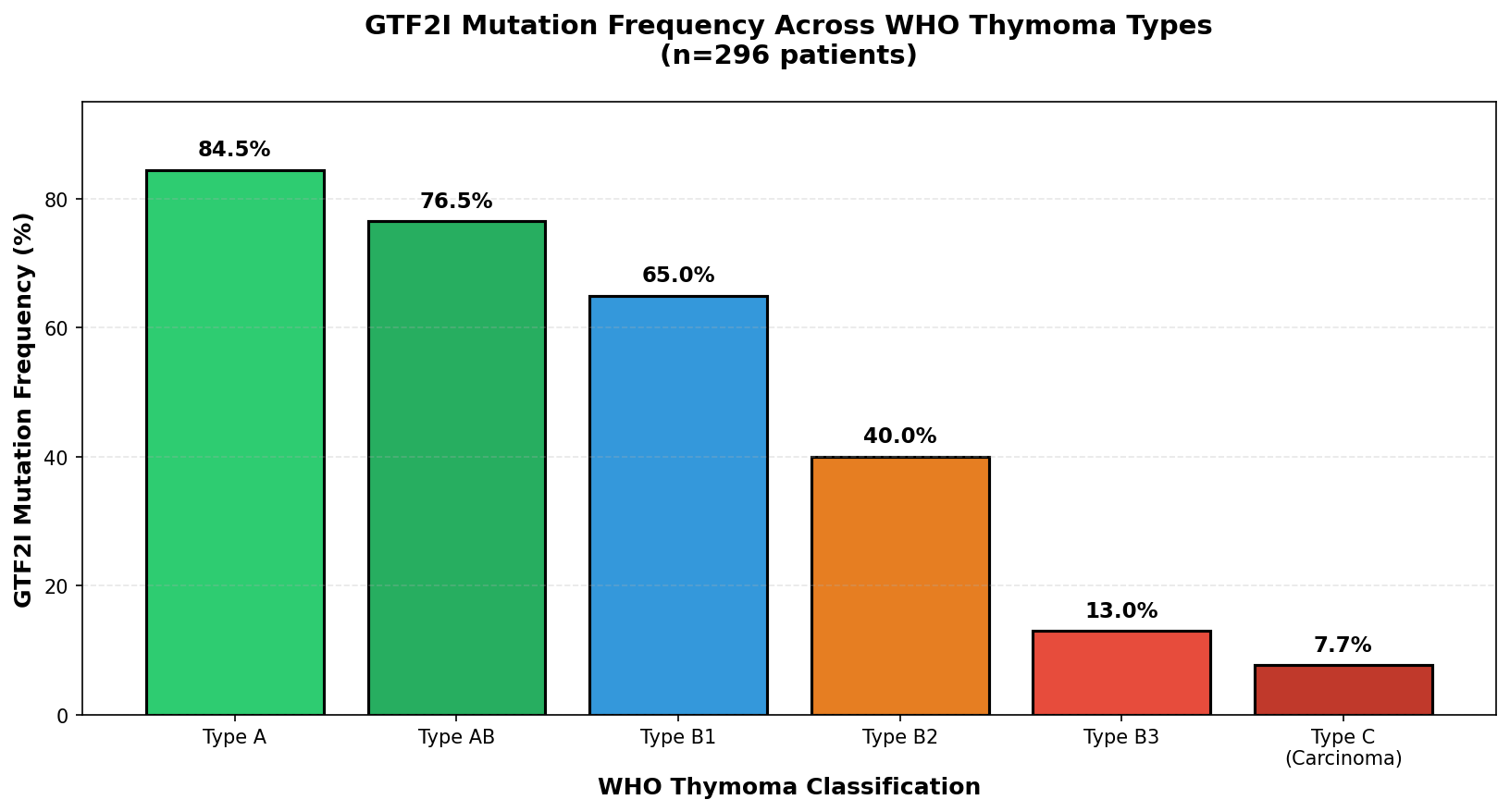
Figure 1: The frequency of GTF2I mutations varies across thymic tumour types. The figure should be interpreted as a summary of published study data rather than a prediction for an individual patient.
TP53 and other changes linked with more aggressive disease
TP53 is a tumour-suppressor gene. It suppresses tumours by repairing damaged DNA, stopping cells from dividing improperly, and causing apoptosis in severely damaged cells. TP53 mutations are more common in thymic carcinoma and in some advanced or aggressive thymic epithelial tumours than in typical thymoma.
A TP53 mutation may be a warning sign of more aggressive tumour biology, but it does not by itself determine treatment. Treatment decisions should be based on the whole clinical picture and discussed by a specialist multidisciplinary team.
Other genes and pathways
Researchers have identified changes in several other genes and cell-signalling pathways. These findings are helping scientists understand how thymic tumours develop and may lead to new treatments, but many are not yet used routinely to choose treatment. One study that examined the characteristics of genomic and signalling pathways in epithelial tumours found the following genetic changes, exclusive to thymomas, which could help in the development of tailored treatment for thymoma patients. The genes involved were;
ZNF429 gene with the highest mutation frequency in thymic carcinoma. Mutations in BAP1, ABI1, BCL9L, and CHEK2 were exclusively detected in thymic carcinoma, whereas ZNF721 mutations and PABPC1were found exclusively in thymoma. The ErbB signalling pathway was enriched in the thymoma group, whereas MAPK signalling was found only in that group.
Because thymic tumours are rare, many genetic findings come from small studies. Results should therefore be interpreted cautiously.
How genetics fits with tumour type and stage
The World Health Organisation (WHO) classifies thymomas as types A, AB, B1, B2 and B3. Thymic carcinoma is classified separately. These categories are based mainly on what the tumour looks like under the microscope and the types of cells present. Genetic patterns overlap with these groups but do not define them perfectly.
Stage describes how far the tumour has grown or spread. In general, stage and the ability to remove the tumour completely are among the most important factors affecting treatment and prognosis. Survival statistics from older studies may differ from modern outcomes and should not be used to predict an individual’s survival.
Can genetic testing change treatment today?
Genetic testing may be considered when a thymic tumour is advanced, has returned after treatment, or when the result could identify a clinical trial or a possible targeted treatment. It is not yet established that every newly diagnosed thymoma needs broad genetic profiling.
For many people, treatment is guided mainly by stage, tumour type and whether complete surgery is possible. Surgery is the main treatment for resectable thymoma. Depending on the situation, chemotherapy and/or radiotherapy may also be used.
Some genetic findings may be actionable in selected patients, particularly in thymic carcinoma. However, targeted treatment is usually considered on a case-by-case basis, often after standard treatment options have been reviewed.
A careful word about immunotherapy
Some thymic epithelial tumours express PD-L1, a protein involved in immune signalling. However, PD-L1 expression alone does not reliably identify who will benefit from immunotherapy. Immune checkpoint inhibitors can cause serious immune-related side effects in people with thymic epithelial tumours, including inflammation affecting muscles, the heart or other organs. These medicines are therefore used cautiously and are generally considered in selected patients, particularly those with recurrent thymic carcinoma.

Figure 2: The immune environment of thymic tumours is complex. Proposed immune “types” are research concepts and are not yet standard tools for choosing treatment.
What should you ask your cancer team?
- What type and stage of thymic tumour do I have?
- Can the tumour be completely removed with surgery?
- Would genetic testing change my treatment or help identify a clinical trial?
- If a mutation was found, what is known about its clinical importance?
- Are there treatment risks that are particularly relevant to my medical history?
Key points
- GTF2I mutations are common in several thymoma subtypes and are generally associated with less aggressive clinical features
- TP53 and some other alterations are more common in aggressive thymic epithelial tumours, but no single mutation determines a person’s outcome
- Stage, tumour type and complete surgical removal remain central to treatment planning
- Genetic testing can sometimes identify research opportunities or targeted treatments, especially in advanced disease
- Immunotherapy may help selected patients but carries an important risk of severe immune-related side effects in thymic epithelial tumours
References/Helpful Resources
- National Cancer Institute. Thymoma and Thymic Carcinoma Treatment (PDQ®) [Internet]. Cancer.gov. 2024 Oct [cited 2026 Aug 14]. Available from: https://www.cancer.gov/types/thymus-cancer/hp/thymoma-treatment-pdq
- Eren M, Boe AE, Murphy SB, Place AT, Nagpal V, Morales-Nebreda L, et al. PAI-1-regulated extracellular proteolysis governs senescence and survival in Klotho mice. Proceedings of the National Academy of Sciences of the United States of America [Internet]. 2014 [cited 2026 Aug 14];111(19):7090–5. Available from: https://pubmed.ncbi.nlm.nih.gov/24778222/
- Ardeshir-Larijani F, Schneider BP, Althouse SK, Radovich M, Masood A, Perna F, et al. Clinicogenomic landscape of metastatic thymic epithelial tumors. JCO precision oncology [Internet]. 2023 Feb [cited 2026 Aug 14];7:e2200465. Available from: https://pubmed.ncbi.nlm.nih.gov/36787505/
- Gaiser T, Hirsch D, Porth I, Sahm F, Ströbel P, von Deimling A, et al. DNA-Methylation analysis as a tool for thymoma classification. Cancers [Internet]. 2022 Nov 29 [cited 2026 Aug 14];14(23):5876. Available from: https://www.ncbi.nlm.nih.gov/pmc/articles/PMC9738683/
- Elm L, Levidou G. The molecular landscape of thymic epithelial tumors: A comprehensive review. International journal of molecular sciences [Internet]. 2024 [cited 2026 Aug 14];25(3):1554. Available from: https://pubmed.ncbi.nlm.nih.gov/38338833/
- Agrafiotis AC, Siozopoulou V, Hendriks JMH, Pauwels P, Koljenovic S, Van Schil PE. Tumor microenvironment in thymic epithelial tumors: A narrative review. Cancers [Internet]. 2022 Oct [cited 2026 Aug 14];14(24):6082. Available from: https://pubmed.ncbi.nlm.nih.gov/36551568/
- Remon J, Villacampa G, Facchinetti F, Di Maio M, Marcuse F, Tiseo M, et al. Immune checkpoint blockers in patients with unresectable or metastatic thymic epithelial tumours: A meta-analysis. European journal of cancer (Oxford, England : 1990) [Internet]. 2023 Feb [cited 2026 Aug 14];180:117–24. Available from: https://pubmed.ncbi.nlm.nih.gov/36592506/
- Yang W, Chen S, Cheng X, Xu B, Zeng H, Zou J, et al. Characteristics of genomic mutations and signalling pathway alterations in thymic epithelial tumors. Annals of translational medicine [Internet]. 2021 Nov [cited 2026 Aug 14];9(22):1659. Available from: https://pubmed.ncbi.nlm.nih.gov/34988168/
- Girard N, Basse C, Schrock A, Ramkissoon S, Killian K, Ross JS. Comprehensive genomic profiling of 274 thymic epithelial tumors unveils oncogenic pathways and predictive biomarkers. The oncologist [Internet]. 2022 Nov 3 [cited 2026 Aug 14];27(11):919–29. Available from: https://www.ncbi.nlm.nih.gov/pmc/articles/PMC9632319/
